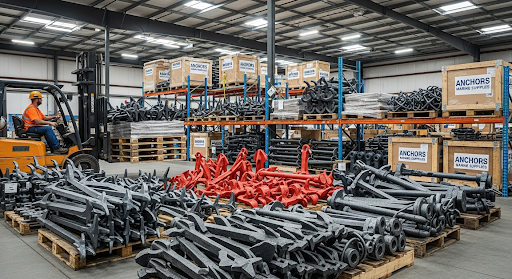
Operational risk management in marine and industrial environments requires control over variables that are often unpredictable, like environmental forces, mechanical stress, regulatory obligations, and asset integrity. Among the many systems that influence risk exposure, anchoring solutions are fundamental yet frequently underestimated. When anchoring systems are designed, sourced, and managed with intent, they become a decisive factor in reducing operational uncertainty rather than a passive safety measure. A structured anchor marine and industrial supply approach strengthens risk management by aligning engineering accuracy, material performance, supply reliability, and lifecycle oversight with real operational conditions. This alignment ensures that anchoring systems actively contribute to stability, compliance, and continuity across offshore, port, and industrial marine operations.
This blog examines how anchoring solutions directly support risk mitigation when integrated into a disciplined operational framework.
Engineering-Controlled Design as a Foundation for Risk Reduction
Engineering-led anchor design forms the first line of defense against operational risk by ensuring predictable performance under defined environmental and load conditions.
- Anchors engineered for specific operational parameters reduce exposure to failure
Anchoring systems designed to match defined load limits, seabed characteristics, and deployment duration deliver predictable holding performance. This predictability reduces the likelihood of anchor drag, unintended movement, and loss of positional control. As a result, operational interventions are minimized, improving overall safety and stability during active marine operations. - Load-path engineering minimizes structural stress across connected systems
Proper load-path design ensures forces are evenly distributed across the anchor, chain, and connection points. Balanced force transfer prevents localized stress concentration and reduces material fatigue over time. This engineering approach significantly lowers the risk of sudden mechanical failure under sustained or variable loads. - Design validation supports informed operational decision-making
Validated engineering documentation provides clear insight into performance limits and safe operating thresholds. Operators can make informed deployment and repositioning decisions based on verified design data. This reduces reliance on assumptions and strengthens risk awareness during critical operational phases. - Standardized engineering reduces human error risk
Uniform anchor designs across fleets simplify handling, installation, and inspection procedures. Standardization improves crew familiarity and reduces confusion during equipment deployment. This consistency lowers the probability of procedural errors caused by mixed or non-standard configurations.
Material Performance as a Critical Risk Control Layer
Material selection and treatment directly influence anchoring reliability, making material performance a decisive factor in controlling long-term marine operational risk.
- High-grade materials maintain integrity under harsh marine exposure
Anchors manufactured from certified steel grades withstand corrosion, pressure variation, and mechanical abrasion. Material resilience preserves structural integrity during prolonged exposure to aggressive marine environments. This durability directly reduces the likelihood of degradation-related failures over extended deployment cycles. - Consistent material properties ensure predictable behavior under load
Uniform tensile strength and controlled material composition enable anchors to respond reliably to dynamic forces. Predictable material behavior supports accurate load calculations and performance forecasting. In contrast, inconsistent materials introduce variability that weakens risk planning and operational control. - Protective treatments extend service life and reduce inspection frequency
Advanced coatings and surface treatments act as barriers against corrosion and surface wear. Reduced degradation slows performance decline and extends operational service life. This durability lowers the risk of unexpected failures between planned inspection intervals. - Material traceability strengthens accountability and compliance
Documented material sourcing enables verification during audits and regulatory assessments. Traceability ensures accountability across manufacturing, testing, and deployment stages. This transparency reduces compliance risk and supports consistent adherence to safety standards.
Supply Discipline and Availability as Risk Stabilizers
A disciplined supply framework reduces uncertainty by ensuring anchoring systems are consistently available, specification-compliant, and operationally ready when required.
- Reliable sourcing prevents operational delays and substitutions
A controlled anchor marine and industrial supply chain ensures timely access to approved equipment configurations. Consistent availability reduces reliance on last-minute sourcing decisions under operational pressure. This discipline minimizes the risk of deploying incompatible or underperforming anchoring components. - Specification consistency eliminates integration risk
Anchors supplied strictly to documented specifications integrate smoothly with chains, connectors, and winches. Technical alignment across components prevents misfit and load transfer inefficiencies. This consistency reduces cascading system risks that often arise from compatibility failures. - Inventory predictability supports contingency planning
Access to predefined anchor types and standardized sizes enables rapid operational response. Predictable inventory availability strengthens contingency planning and decision confidence. This reduces dependence on emergency procurement and associated risk exposure. - Technical support availability enhances on-site risk response
Supplier-backed technical guidance assists crews during installation or performance assessment. Informed adjustments can be made quickly without compromising system integrity. This expertise strengthens real-time risk management during critical operational phases.
Lifecycle Oversight as a Long-Term Risk Management Strategy
Lifecycle governance transforms anchoring systems into managed assets, enabling proactive risk control through inspection, maintenance, and planned replacement.
- Scheduled inspections prevent performance degradation
Anchors managed through defined inspection intervals maintain consistent performance integrity. Regular assessments identify early signs of wear, deformation, or corrosion. This proactive approach reduces the likelihood of failures during high-risk operational phases. - Wear tracking enables data-driven risk forecasting
Monitoring wear patterns over time provides insight into stress exposure and operational intensity. Historical performance data support accurate forecasting of degradation trends. This enables timely intervention before safety margins are compromised. - Maintenance records support regulatory and insurance requirements
Documented lifecycle management demonstrates adherence to recognized safety standards. Clear records streamline regulatory audits and insurance evaluations. This documentation reduces exposure to penalties, disputes, and compliance-related risks. - Planned replacement eliminates emergency intervention scenarios
Replacing anchors before end-of-life thresholds prevents reactive, high-pressure decisions. Planned transitions ensure continuity of operations without safety compromises. This approach significantly reduces the risks associated with rushed or unplanned replacements.
Final Thoughts
Effective operational risk management in marine and industrial environments depends on the deliberate control of systems that influence stability and safety. Anchoring solutions, when engineered, sourced, and managed with precision, serve as a core risk mitigation asset rather than a background component. Engineering accuracy, material integrity, disciplined supply practices, and structured lifecycle management collectively reduce uncertainty and strengthen operational resilience.
Organizations that integrate anchor marine and industrial supply considerations into their broader risk frameworks gain improved predictability, stronger compliance confidence, and enhanced asset reliability. This strategic approach supports safer operations and more informed decision-making across complex marine activities. For professionals seeking a dependable anchors supplier UAE aligned with modern risk management expectations, Wismar Heavy Equipment TRD LLC delivers expertise-driven anchoring systems designed to support operational control and long-term performance.
